by Ber | Apr 5, 2026 | Client Life
It starts innocently. You’re building a wireframe — or a deck, or a landing page mockup — and you need something in the headline slot. Not the real headline. The real headline requires a brief you haven’t received, an insight that hasn’t been approved, and a creative director who’s in a meeting until Thursday. You need placeholder copy. Filler. Something to show the layout works while the actual words are being workshopped through the seven circles of stakeholder approval.
So you type something fast. Something deliberately rough. “Your Future Starts Here.” Or “We Make Things Better.” Or, in a moment of exhaustion-fueled honesty, “Headline Goes Here — Please Replace.” You save the file. You move on. You forget about it entirely. Three weeks later, the campaign launches. Your placeholder copy is on a billboard. Nobody changed it. Nobody noticed it needed changing. And the worst part — the part that haunts you at 3 AM — is that the client loves it.
The Accidental Genius of Not Trying
There’s a cruel irony at the heart of the creative industry: the work you agonize over for weeks often gets killed, while the throwaway line you typed in five seconds while eating a sandwich becomes the campaign headline. This isn’t a bug in the creative process. It’s a feature that reveals an uncomfortable truth about how good ideas actually work.
When you write placeholder copy, you’re free. There’s no brief constraining you. No brand guidelines whispering about tone of voice. No strategy document insisting you hit three key messages in a single sentence. You’re writing for yourself, or for no one, and that freedom produces something that polished, on-brief, committee-approved copy rarely achieves: honesty. The placeholder is often better because it hasn’t been ruined yet. It hasn’t survived seven rounds of feedback from people whose primary creative qualification is having an opinion.
This is why first drafts are frequently better than seventh drafts. Not because revision is bad, but because the revision process in most organizations isn’t about making the work better. It’s about making the work safer. Each round of feedback files down an edge. Each stakeholder’s note removes a risk. By the seventh draft, you haven’t refined the copy. You’ve performed a lobotomy on it. The placeholder, untouched by committee, still has all its edges. And edges are what make people stop scrolling.
The Approval Process: Where Good Copy Goes to Die
The lifecycle of a piece of copy in a corporate environment is a tragedy in five acts. Act One: the copywriter writes something sharp, specific, and alive. Act Two: the creative director adds nuance and polish. Act Three: the account manager suggests it’s “a bit much” and requests “a safer option alongside it.” Act Four: the client’s marketing team has “a few small tweaks” that involve rewriting sixty percent of the text. Act Five: the client’s legal team removes everything that could possibly be interpreted as a claim, a promise, or a statement of any kind. What remains is a sentence so bland it could be the motto of any company in any industry: “Solutions for a better tomorrow.”
The placeholder copy, meanwhile, is sitting in an old version of the file, untouched and brilliant. It said something specific. It had personality. It might even have been funny. But it was never submitted for approval because it was “just placeholder,” and now it exists only in a designer’s Figma history, a ghost of what the campaign could have been.
This is why the best creatives in the industry have learned to smuggle their real ideas into the placeholder slots. If you label something “final copy,” it triggers the immune response of every stakeholder in the approval chain. But if you label it “FPO” — for placement only — it flies under the radar. Sometimes it flies all the way to production. A Fuck The Brief attitude isn’t rebellion — it’s survival. Get the shirt from the NoBriefs shop and wear it to your next copy review.
Lorem Ipsum: The Greatest Writer in Advertising
Lorem ipsum has appeared in more published materials than any copywriter in history. It has graced websites, brochures, annual reports, and at least one municipal government document that made it to print with a full paragraph of fake Latin where the mayor’s message was supposed to be. Lorem ipsum doesn’t have an ego, doesn’t miss deadlines, and has never once asked for a raise. It is, by some metrics, the most successful writer in the history of communication.
The fact that lorem ipsum regularly makes it to final production isn’t funny. Well, it is funny. But it’s also a damning indictment of how many people in the approval chain actually read the work they’re approving. When a paragraph of pseudo-Latin survives review by a project manager, an account director, a client-side marketing lead, and a proofreader, it means that at least four people clicked “approve” without reading. Which raises the question: if nobody reads the placeholder, are they reading the real copy? And if they’re not reading the real copy, what exactly is the approval process approving?
The answer, of course, is that the approval process isn’t about the copy. It’s about the process. It’s about the audit trail, the sign-off sheet, the chain of accountability that ensures that when something goes wrong, there’s a documented record of who approved it. The words themselves are secondary to the workflow. Which explains why placeholder copy survives: it’s not that people approved it. It’s that people approved the document it was in, and the words were just along for the ride.
The Placeholder as Creative Philosophy
What if, instead of treating placeholder copy as a problem to be solved, we treated it as a creative method? What if the best way to write a headline isn’t to start with the brief, the strategy, and the key messages, but to start with the instinct — the fast, unfiltered, placeholder version — and protect it from the machinery that will inevitably try to sand it down?
The best creative directors already do this intuitively. They know that the first reaction, the gut response, the thing you say before you’ve had time to second-guess yourself, is often the most powerful. They also know that the client approval process will try to kill it, which is why they present the placeholder as the recommendation and the safe option as the backup. The trick isn’t writing better copy. It’s building a process that doesn’t destroy the good copy you’ve already written. Think of it as KPI Shark thinking applied to words: measure what actually bites, not what looks safe on the deck.
So the next time you type “headline goes here,” pause before you delete it. Read it again. Is it actually better than what you’d write if you spent three days crafting the perfect line? If the answer is yes — and it will be more often than you’d like to admit — then maybe the placeholder isn’t the placeholder. Maybe it’s the headline. And maybe the three days of crafting were always just an expensive way of arriving back where you started.
The best ideas are the ones that survive the process. The best-best ideas are the ones that skip it entirely. Stay unpolished, stay honest, stay dangerous — and find your people at nobriefsclub.com.

by Ber | Apr 5, 2026 | Brand & Design
Once upon a time — around 2018, give or take a TED talk — someone had a genuinely good idea. What if brands stood for something beyond profit? What if companies used their platforms and resources to address social issues, environmental concerns, and systemic inequities? What if the brands that did this authentically would be rewarded by consumers who increasingly cared about where their money went? It was elegant. It was idealistic. It was, for about eighteen months, even true.
Then everyone else showed up. Every fast-fashion brand discovered sustainability. Every bank discovered financial inclusion. Every tech company discovered digital wellbeing, which is like a cigarette company discovering lung health — technically possible, fundamentally absurd. Brand purpose went from a radical rethinking of corporate responsibility to a mandatory checkbox on every brand strategy deck, and somewhere in that transition, the meaning evaporated like morning dew on a freshly greenwashed supply chain.
The Golden Age of Actually Meaning It
The brands that pioneered purpose-driven marketing did so because they meant it. Patagonia told customers to buy less clothing — their own clothing included — because they genuinely believed overconsumption was destroying the planet. The founder literally gave the company away to an environmental trust. That’s not a marketing strategy. That’s a belief system with a supply chain attached.
Ben & Jerry’s embedded social activism into their corporate DNA decades before it was fashionable. They named flavors after political causes, took public stands on issues that made shareholders nervous, and accepted that being controversial was the cost of being genuine. These weren’t brands that discovered purpose. They were purposes that discovered they could also sell products.
The difference between these brands and what followed is the difference between a person who volunteers at a shelter every weekend and a person who posts about volunteering to get more Instagram followers. Both produce the same outward signal. One is driven by conviction. The other is driven by conversion metrics. And consumers, despite what marketers want to believe, can usually tell the difference. It’s the KPI Shark instinct — the ability to smell blood in the water when a brand’s purpose is just performance.
The Purpose Industrial Complex
The problem with good ideas in marketing is that they become frameworks. Frameworks become templates. Templates become commodities. And commodities become meaningless. Brand purpose followed this trajectory with remarkable speed.
By 2020, every branding agency on earth had a “purpose workshop” in their service offering. The process was always the same: gather the leadership team, explore the company’s “why,” align on a purpose statement that connects the business to a broader social good, and distill it into a sentence that can fit on a slide, a website, and — critically — an advertising campaign. The output was always the same too: a vaguely inspirational statement about “empowering people” or “creating a better world” or “unlocking human potential” that could apply to any company in any industry at any point in human history.
The purpose industrial complex created a peculiar species of corporate communication: the manifesto ad. You know the format. Dramatic music. Slow-motion footage of diverse humans doing meaningful things. A voiceover that sounds like a commencement speech written by someone who just discovered Brené Brown. A logo reveal at the end that could be for a bank, a car company, a phone brand, or a sustainable yogurt startup. The content is interchangeable because the purpose is interchangeable. When every brand claims to exist for a reason beyond profit, the claim itself becomes profitless.
The Authenticity Test Most Brands Fail
Here’s a simple test for whether a brand’s purpose is real: would the company still pursue it if nobody knew? If Patagonia’s environmental commitments were invisible to customers — no marketing, no press, no social media — would they still do it? Almost certainly yes. If a major oil company’s “sustainability initiative” were invisible to the public, would they still fund it? The silence from the back of the room is your answer.
Real purpose is expensive. It requires trade-offs that affect the bottom line. It means turning down profitable opportunities that conflict with your stated values. It means making decisions that make shareholders uncomfortable. It means, occasionally, choosing the right thing over the profitable thing and accepting the financial consequences. Very few publicly traded companies are willing to do this, which is why very few publicly traded companies have a credible claim to purpose beyond “returning value to shareholders.”
The brands that fail the authenticity test — and there are many — don’t just waste their own marketing budgets. They poison the well for everyone. Every hollow purpose campaign makes consumers more cynical, more resistant, more likely to dismiss even genuine efforts as marketing ploys. The brands that faked it didn’t just fail at purpose. They made purpose harder for everyone else. Which is ironic, given that “making the world better” was supposedly the whole point.
Purpose After the Backlash
We’re now in the hangover phase of brand purpose. The backlash is real and, in many cases, deserved. “Woke capitalism” became a political football. Purpose fatigue set in among consumers who were tired of being sold soap with a side of social commentary. Some companies retreated entirely, stripping purpose language from their websites and quietly shelving their manifesto ads. Others doubled down, producing increasingly elaborate displays of commitment that somehow felt less convincing with each iteration.
What comes next isn’t the death of brand purpose. It’s the maturation of it. The brands that survive the backlash will be the ones that moved past purpose as a communication strategy and embedded it as an operational reality. Not “we believe in sustainability” but “we changed our manufacturing process and it cost us 12% more and here are the specific environmental outcomes.” Not “we stand for inclusion” but “here are our hiring numbers, our pay equity data, and the three areas where we’re still failing.” Specificity is the antidote to purpose fatigue. It’s harder to fake a spreadsheet than a manifesto — though the Spreadsheet Sloth on the NoBriefs shop would argue that spreadsheets deserve a slower, more honest pace too.
Purpose isn’t dead. But the version of it that lived on advertising campaigns and died in board meetings? That version deserved to go. What replaces it needs to be quieter, more specific, and more willing to admit failure. In other words, the opposite of everything marketing has trained us to do.
Believe in something. Or don’t. But for the love of all that is sacred, stop pretending your quarterly earnings call is a social movement. Real talk, real merch, real irreverence — only at nobriefsclub.com.

by Ber | Apr 5, 2026 | Brand & Design
There was a moment — historians will debate exactly when, but sometime around 2016 — when someone in a Human Resources department opened Instagram, saw a competitor’s “day in the life” reel featuring beanbag chairs and cold brew on tap, and thought: “We need that.” Not the beanbag chairs. Not the cold brew. The perception. The carefully curated illusion that working at their company was less a job and more a lifestyle choice, like CrossFit or veganism but with dental insurance.
Thus employer branding was born. Or rather, reborn — because companies have always marketed themselves to potential employees. They just used to do it honestly: “We pay competitive salaries and you get three weeks off.” Now they do it with drone footage of the office, testimonials from suspiciously photogenic employees, and a careers page that reads like the manifesto of a particularly earnest co-working space. Welcome to the awkward marriage of HR and Marketing, where nobody agrees on the message and everyone agrees on the beanbags.
The Authenticity Arms Race
The central paradox of employer branding is that it demands authenticity while being, by definition, a marketing exercise. You cannot simultaneously “show the real culture” and “attract top talent” without editing. Every employee testimonial is selected, coached, and approved. Every office photo is staged, lit, and filtered. Every “we’re not perfect, but we’re working on it” statement has been reviewed by Legal, revised by Communications, and sanitized until the imperfections themselves feel curated.
The result is a genre of content that everyone recognizes as performance and nobody trusts. Job seekers scroll through careers pages the way they scroll through dating profiles: aware that the photos are the best-case scenario, that the bio emphasizes strengths and hides red flags, and that the reality will be revealed approximately three weeks after commitment. The company says “we value work-life balance” and the candidate mentally translates this to “we would like to value work-life balance but have not yet figured out how.”
The authenticity arms race has created its own absurdities. Companies now hire photographers to capture “candid” moments that are anything but candid. They produce “unscripted” employee videos with production values that would make a documentary filmmaker envious. They share “behind the scenes” content that has been through more review cycles than the annual report. It’s a hall of mirrors where everyone is performing naturalness, and the performance is so polished that it achieves the opposite of its intent. Much like putting a Spreadsheet Sloth on a motivational poster — the dissonance is the point. Grab yours from the NoBriefs shop.
The Turf War Nobody Admits Exists
Employer branding sits in the organizational chart like a child of divorced parents who both insist they have custody. HR owns the employee experience, the culture, the policies, and the onboarding. Marketing owns the brand, the visual identity, the tone of voice, and the content strategy. Employer branding needs both, belongs to neither, and is usually managed by whichever department had budget available when the initiative was approved.
This creates a tonal schizophrenia that’s visible from space. The careers page, built by Marketing, is sleek, aspirational, and on-brand. The job descriptions, written by HR, read like legal documents crossed with a wish list from a hiring manager who wants a unicorn at a donkey’s salary. The social media content alternates between polished brand videos and awkward photos of the office birthday celebration where Dave from Accounting is caught mid-sneeze. The employee value proposition promises “growth, impact, and belonging” while the Glassdoor reviews mention “micromanagement, unclear promotion criteria, and a kitchen that’s never clean.”
The turf war isn’t just about control. It’s about fundamentally different worldviews. HR thinks in terms of policies, compliance, and employee satisfaction surveys. Marketing thinks in terms of narratives, audiences, and conversion funnels. When these worldviews collide on a careers page, you get a document that’s simultaneously trying to comply with employment law and create an emotional brand connection. It’s like asking someone to write a love letter in legalese.
The Glassdoor Reckoning
The cruelest thing about employer branding is that it exists in the same internet as Glassdoor, Blind, Reddit, and every other platform where current and former employees share unfiltered opinions. You can spend six figures on a careers video and a disgruntled ex-employee can neutralize it with a three-star review and two paragraphs about the toxic middle management layer.
This isn’t a bug. It’s the market correcting for decades of corporate dishonesty. Before the internet, companies controlled their employer narrative completely. The only way to know what it was like to work somewhere was to know someone who worked there. Now, the information asymmetry has flipped. Candidates often know more about a company’s internal culture than the recruiter pitching them the role. They’ve read the reviews. They’ve seen the Reddit threads. They’ve decoded the job description’s euphemisms: “fast-paced” means chaotic, “wear many hats” means understaffed, and “competitive salary” means we’ll offer you the minimum we think you’ll accept.
The companies winning the employer branding game aren’t the ones with the best content. They’re the ones where the content matches the reality. Where the careers page and the Glassdoor reviews tell roughly the same story. Where the employee testimonials don’t require employees to pretend they work somewhere better than they do. This is rare, which is exactly why it works when it happens.
The Way Forward (If There Is One)
The future of employer branding isn’t more polished content. It’s less polished promises. It’s companies admitting, publicly and specifically, what they’re good at and what they’re not. It’s job descriptions that say “this role is demanding and the hours are long, but the work is meaningful and the team is exceptional” instead of pretending every position is a perfect balance of challenge and comfort.
It’s recognizing that employer branding isn’t a campaign. It’s a mirror. You can polish the mirror all you want, but it’s still going to reflect whatever’s standing in front of it. The best employer brand strategy isn’t better marketing. It’s a better workplace. Everything else is just KPI Shark metrics — impressive on a dashboard, meaningless in the hallway.
Stop selling the dream. Start fixing the reality. And if you need a reality check that fits in a coffee mug, the NoBriefs shop has options for every level of corporate disillusionment.
by Ber | Apr 5, 2026 | Brand & Design
Open your phone. Look at your home screen. Count the blue icons. Facebook, LinkedIn, Twitter (yes, it’s still blue in spirit even if Elon painted it black), Zoom, Samsung, PayPal, Venmo, Dropbox, Skype. Your phone looks less like a collection of individual brands and more like a mood board for sadness. The entire digital economy has been bathed in a single color, and nobody in the branding industry wants to talk about why.
The official explanation involves color psychology, which is the astrology of design disciplines. Blue conveys trust, stability, professionalism. It’s universally inoffensive. It tests well across demographics. It works on light backgrounds and dark backgrounds. It’s accessible. It’s calm. It’s — and here’s the part they don’t say out loud — the safest possible choice for a decision-maker who is terrified of being wrong.
The Psychology Excuse
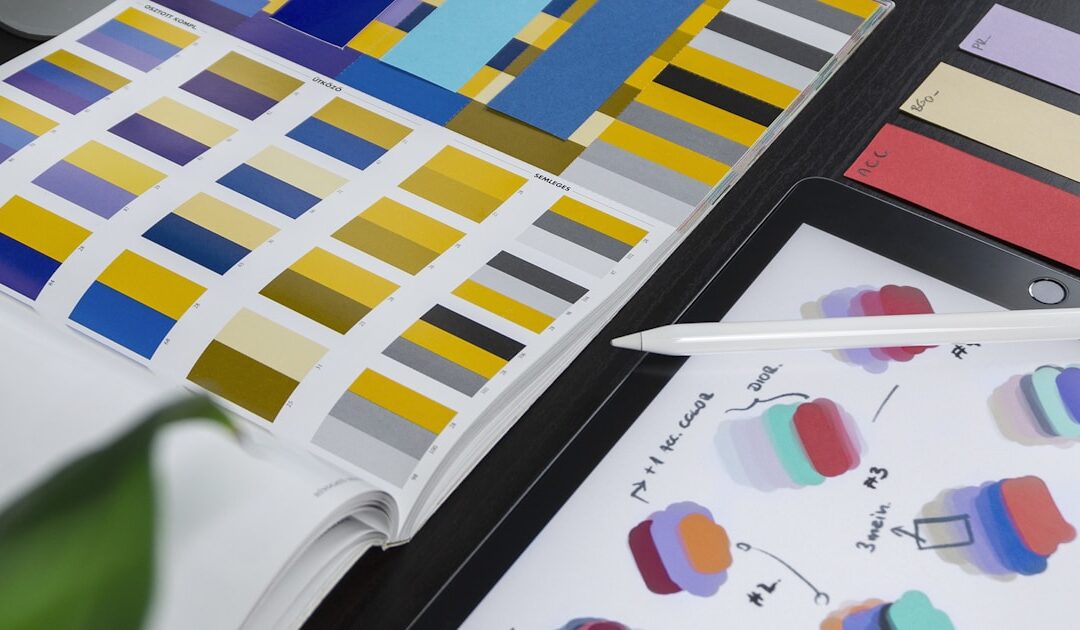
Color psychology is one of those fields where a kernel of legitimate research has been inflated into an entire consulting industry. Yes, colors carry cultural associations. Yes, warm colors tend to feel more energetic than cool colors. Yes, there are measurable differences in how people respond to different parts of the visible spectrum. But the leap from “blue has calming associations in Western cultures” to “your fintech startup must be blue or customers won’t trust you with their money” is the kind of logic that keeps branding agencies in business and the Pantone blue swatch collection in perpetual demand.
The truth is less scientific and more sociological. Blue became the default because the first major tech companies chose blue, and every company after that looked at the successful ones and said, “We should also be blue.” It’s not color psychology. It’s herd behavior with a design rationale bolted on after the fact. Facebook is blue because Mark Zuckerberg is red-green colorblind and blue was the color he could see best. That’s it. That’s the origin story of the most influential color decision in digital history. Not research. Not strategy. An accident of biology that launched a thousand copycats.
Yet try presenting a non-blue palette to a board of directors for a technology company. Watch the room temperature drop. Watch the CFO lean forward and ask, “But don’t users associate blue with trust?” Watch the CEO pull up Facebook on their phone as if a trillion-dollar company’s color choice is a peer-reviewed study. The psychology excuse isn’t driving the decision. The fear of being different is driving the decision, and psychology is the respectable-sounding justification.
The Committee Color Wheel
Every bold color choice begins in a designer’s studio and dies in a conference room. The journey is always the same. A designer presents three directions: one safe, one interesting, one provocative. The provocative one uses orange, or pink, or — God forbid — yellow. It’s distinctive. It’s memorable. It’s the one the designer has been refining at 2 AM because they genuinely believe it’s right for the brand.
The committee picks blue. Not because they evaluated each option on its strategic merits. But because blue is the only color in the presentation that nobody has a strong opinion against. Red is “too aggressive.” Green is “too environmental” (unless you are environmental, in which case green is “too expected”). Orange is “too playful.” Purple is “too luxury.” Pink is “too feminine” — a statement that reveals more about the committee than the color. Yellow is “hard to read.” Black is “too dark.” And blue? Blue is “professional.” Blue is “safe.” Blue is the color of not getting fired for a branding decision.
This is how design by committee works: not by choosing the best option, but by eliminating every option that makes someone uncomfortable. What remains isn’t a decision. It’s a default. The KPI Shark doesn’t swim in safe waters — and neither should your brand identity. Grab one from the NoBriefs shop as a reminder that playing it safe is the riskiest strategy of all.
The Brands That Broke the Mold (and What Happened)
The most iconic brands in the world aren’t blue. Coca-Cola is red and has been since the 1890s. Ferrari is red. McDonald’s is red and yellow. Spotify is green. T-Mobile is magenta and has literally trademarked the color. Hermès is orange. Tiffany’s blue is so specific and so owned that it’s less “blue” and more “a legal entity in color form.”
What these brands share isn’t a color. It’s conviction. They chose a color and committed to it with the kind of unwavering confidence that most branding committees can’t muster. T-Mobile didn’t become magenta because research said magenta conveys “innovative telecommunications.” They became magenta because it was impossible to confuse with AT&T blue or Verizon red. It was a competitive decision, not a psychological one. And it worked precisely because it was different.
The lesson isn’t that blue is bad. Blue is fine. IBM has been blue since before most of us were born, and it works for them. The lesson is that choosing blue because you’re afraid of choosing anything else isn’t a brand strategy. It’s a coping mechanism. And a brand built on fear of distinction is a brand that’s already decided to be forgettable.
The Brave New World of Beige
If blue is the coward’s choice for technology brands, the new frontier of chromatic conformity is the millennial-to-Gen-Z startup palette: soft gradients, muted pastels, and an inexplicable amount of lavender. Every DTC brand launched since 2018 looks like it was designed inside an Instagram filter. The colors whisper rather than speak. They suggest wellness, mindfulness, and the vague sense that someone with a curated bookshelf approved this.
This is blue-ification in a different costume. The impulse is identical — choose colors that won’t offend, that blend into the aesthetic of the moment, that signal belonging to a tribe rather than standing apart from it. The palette has shifted from corporate navy to millennial blush, but the underlying cowardice is the same. Nobody ever got fired for choosing a color that matches the current cultural vibe. And nobody ever built a legendary brand by matching the current cultural vibe, either.
Color in branding isn’t decoration. It’s a decision. It’s one of the few decisions that every single person who encounters your brand will process, consciously or not, in the first fraction of a second. It deserves more than a committee vote and a psychology article pulled from the first page of Google. It deserves Fuck The Brief energy — the audacity to choose something that makes the room uncomfortable and defend it with strategy, not safety.
Your brand is not a democracy, and your color palette is not a compromise. Pick something that means something. Pick something that scares the committee. And if they insist on blue, at least make sure it’s the most aggressive, unapologetic blue they’ve ever seen. More brand heresies at nobriefsclub.com.

by Ber | Apr 5, 2026 | AI & The Future of Creative Work
Every six months, a new wave of AI-generated imagery floods the internet, and the same two camps emerge with the predictability of a brand strategy deck. Camp One: “AI is a tool, just like Photoshop was a tool, and creatives who adapt will thrive.” Camp Two: “This is the end of creativity as we know it, and we’re all going to be replaced by a teenager with a subscription.” Both camps are wrong, but in interestingly different ways, and the truth — as usual — is more uncomfortable than either narrative allows.
The creative of the future won’t be replaced by AI. But they also won’t simply be “augmented” in the clean, optimistic way that conference keynotes suggest. What’s actually happening is something messier: a fundamental restructuring of what creative work means, who gets to do it, and what we consider valuable about the human contribution. Spoiler: it’s not the part most creatives think it is.
The Myth of the Augmented Creative
The “augmented creative” narrative is comforting because it suggests continuity. You’ll still be a designer, a writer, a director — you’ll just have better tools. It’s the same story the industry told when desktop publishing arrived, when the internet happened, when social media turned every brand into a content factory. And like those previous disruptions, it’s partially true and mostly misleading.
What desktop publishing actually did was eliminate an entire profession — typesetters — while creating new roles that didn’t exist before. The internet didn’t augment print journalists; it destroyed the business model that paid their salaries and replaced it with something fundamentally different. Social media didn’t give creative directors more channels; it gave every intern with a phone the ability to bypass the creative department entirely.
AI will follow the same pattern. It won’t augment existing creative roles so much as dissolve the boundaries between them. When a strategist can generate visual concepts without a designer, when a product manager can produce copy without a writer, when a client can create “good enough” creative without an agency — the question isn’t whether creative professionals will exist. It’s what, specifically, they’ll be paid to do that a machine can’t approximate for a fraction of the cost.
The Taste Gap
Here’s the inconvenient truth that both AI evangelists and AI doomsayers miss: the hardest part of creative work was never the execution. It was knowing what to execute. It was taste, judgment, strategic thinking, and the ability to look at a hundred options and know which one will actually work — not because of data, but because of an accumulated understanding of culture, context, and human behavior that no model currently possesses.
AI can generate a thousand logo concepts in minutes. It cannot tell you which one will resonate with your specific audience, align with your brand strategy, and still look good embroidered on a cap. AI can write a dozen headline variations before you finish your coffee. It cannot feel the difference between clever and try-hard, between provocative and offensive, between simple and simplistic. That gap — the taste gap — is where the creative of the future lives. Maybe they should live there wearing a Fuck The Brief shirt from the NoBriefs shop, because the brief itself is about to get a lot weirder.
The problem is that taste is difficult to quantify, harder to teach, and almost impossible to sell in a procurement process that wants deliverables, timelines, and hourly rates. You can’t put “I’ll know the right answer when I see it” on an invoice. And yet that’s increasingly the most valuable thing a creative professional brings to the table.
The Prompt Babysitter Economy
What nobody is talking about — because it’s deeply unglamorous — is the emerging role of the creative as quality control inspector. Not the visionary art director steering a campaign from concept to execution. Not the writer crafting perfect sentences in a sunlit studio. But the person sitting between the AI output and the final product, fixing the weird hands, rewriting the sentences that sound slightly off, ensuring the brand voice doesn’t drift into uncanny valley territory.
This is the prompt babysitter: someone whose primary skill is recognizing when the machine has produced something good enough and when it hasn’t. It’s less romantic than “creative director” and more honest about what most AI-assisted work actually looks like in practice. You generate. You evaluate. You regenerate. You tweak. You spend more time editing machine output than producing original work. The craft shifts from creation to curation, from making to selecting.
Is this the future creatives signed up for? Absolutely not. Is it where a significant portion of the industry is headed? Almost certainly. The agencies that thrive won’t be the ones with the most talented individuals; they’ll be the ones that build the best systems for turning AI output into consistently excellent work. Process will eat talent for breakfast, and the Spreadsheet Sloth will become the industry’s spirit animal — slow, methodical, hanging upside down from a tree of data.
The Human Premium
But here’s where the story gets interesting. In a world of infinite AI-generated content, human-made creative work doesn’t become worthless. It becomes rare. And rarity, in any market, creates value. We’re already seeing this in other fields: handmade furniture commands a premium over IKEA not because it’s objectively better at holding books, but because someone made it. Vinyl records outsell digital downloads not because the sound quality justifies the price, but because the physical artifact means something.
The creative of the future might not be augmented or replaced. They might be artisanal. The premium won’t be on what you produce but on how you produce it — and whether a human brain, with all its beautiful inefficiency, was involved in the process. The best creatives won’t compete with AI on speed or volume. They’ll compete on meaning, on originality, on the kind of unexpected connections that only come from a mind that has lived a life, not trained on a dataset.
The future of creativity isn’t about the tools. It’s about what you do when the tools can do everything except think. Stay sharp, stay human, and stay weird. That’s the only competitive advantage that matters. Find more heretical perspectives at nobriefsclub.com.